




The .211 Remington Fireball Revisited
Date: Dec 15 2021
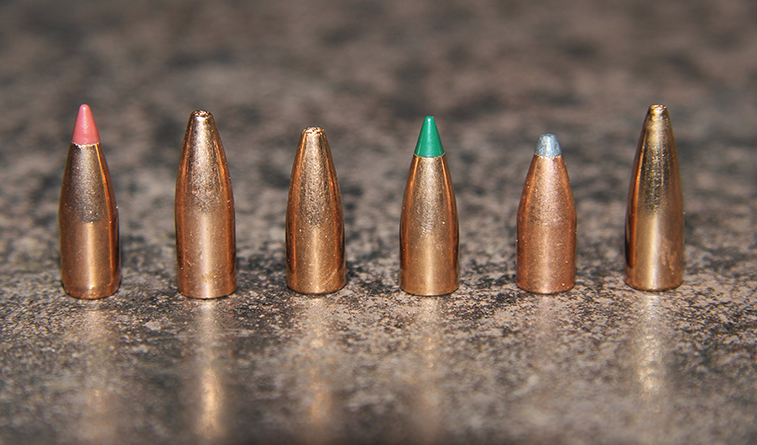
Barnes 36-grain Varmint Grenade, Berger 40-grain Flat Base Varmint, Sierra 40-grain BlitzKing, Sierra 45-grain
Soft Point Hornet and Speer 50-grain TNT.
I’ve become a “YUGE” fan of the .221 Remington Firefall. This hinges entirely on the cartridge’s pleasant shooting demeanor, which is largely a result of the Fireball’s stellar efficiency. The .221 Fireball, in fact, provides 90 percent of the performance of the more popular .223 Remington, while burning just 60 percent of the powder. The Fireball was created by shortening the .222 Remington case to allow peak performance from the 10.5-inch barrel of the company’s 1963 released XP-100 pistol, so this isn’t too surprising. Shortening the .222/.223 case created a more concentrated powder column that is now all the rage in cartridge development, just on a smaller scale.
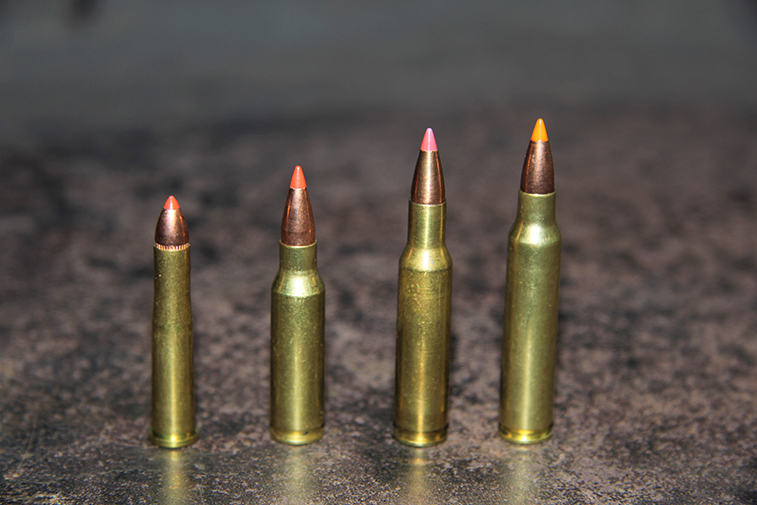
.221 Remington Fireball under discussion here, .222 Remington
and .223 Remington.
The Fireball was derived from the .222 Remington case.
My affection for the Fireball started with .221 Remington Fireball handguns, a 10-inch barrel for my Thompson/Center (T/C) Contender, and later, a 1960s-vintage Remington XP-100. I was impressed enough to seek a rifle, discovering a rechambered Remington Model 788. Bedded into a Boyd’s Zombie Green Thumbhole Featherweight stock, the rifle shoots quite well, despite its thin barrel, which heats quickly during high-volume varmint shooting. The heating issue prompted the purchase of a heavier Remington stainless steel take-off barrel measuring .82 inch at the muzzle.
That barrel laid around a while, until meeting Wayne York, owner of Oregunsmithing in Pendleton, Oregon. During some casual eastern Oregon ground squirrel shooting, Wayne suggested mounting that barrel on Howa’s 1500 Mini Action, which he uses as the base for his custom .24 and .25 York rifles – hugely-efficient proprietary wildcats created by necking down the 6.8 Remington SPC.
The barrel was machined for compatibility with the Howa’s metric threads, and threaded to accept my .223 Remington/5.56mm suppressor, everything trued and bedded into one of York’s good-looking Long Range Hunter Pendleton Composite Stocks (PCS). PCS stocks are handlaid using Kevlar, carbon fiber, a proprietary epoxy and construction that includes stainless steel pillars and cross-pins reinforcing the magazine well and wrist. The stock weighs just 20 ounces and fits me like a glove. York produces remarkable milled-aluminum bottom metal, including a hinged floorplate and top-load magazine, but I liked the idea of a detachable magazine for varmint shooting, so we stuck with the factory polymer setup. Howa actions include tight tolerances and run slicker than snot. Wayne also honed the Howa two-stage trigger to break at a crisp 1.25 pounds. Scoped with a proven Vortex Viper PST 6-24x 50mm scope, the rifle weighs 9.46 pounds. I was more than a little giddy with the results.
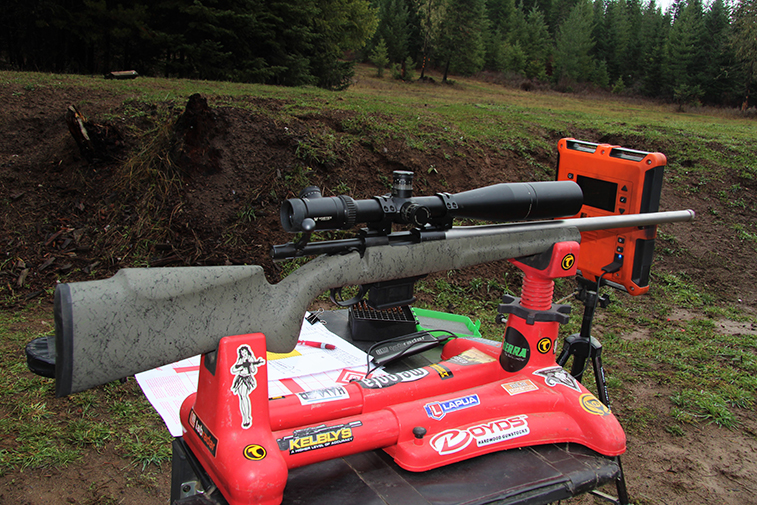
Velocities were established using a LabRadar Doppler unit, which allows determining velocity under overcast skies.
But would it shoot?
This is always the question when taking possession of a new rifle I have waited so eagerly for. I had conducted extensive load development for my Remington 788 rifle, so I was anxious to see how the new rifle would compare while shooting some of those proven loads. With one possible exception, only the most temperature stable and cleanest-burning powders were retained for this series.
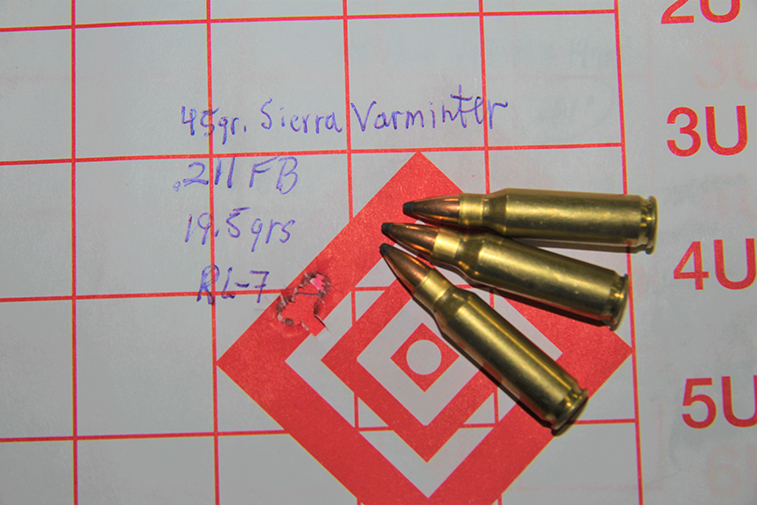
Alliant Reloder 7 under Sierra’s 45-grain Varminter SPT, created this .29-inch group
during sight-in. Sierra 45-grain Soft Point Hornet bullets were substituted for this test.
Regarding the .221 Fireball, the powder to judge all others by is Hodgdon’s CFE BLK. This “Blackout” powder seems custom-made for the Fireball, providing excellent accuracy, top velocities and Hodgdon’s Copper Fouling Eraser (CFE) for cleaner barrels. Most importantly, it produces velocities exceeding or matching Fireball favorites, but at much lower chamber pressures – like 4,000 to 5,000 psi lower. Accurate’s A-1680 is another “Blackout” favorite, as well as Shooters World Blackout. Also included was Hodgdon H-322 – part of the company’s temperature-stable Extreme Series – with the heaviest bullet and Lil’Gun, Alliant Reloder 7 and 10X, Vihtavuori N110, N120 and N130, Accurate A-2200 and Norma 200. Of these, Hodgdon’s Lil’Gun is suspect in regard to cleanliness, but the velocity generated is difficult to ignore. Reloder, Vihtavuori and Accurate powders aren’t exactly new, but have undergone continuous improvements to boost consistency and cleanliness.
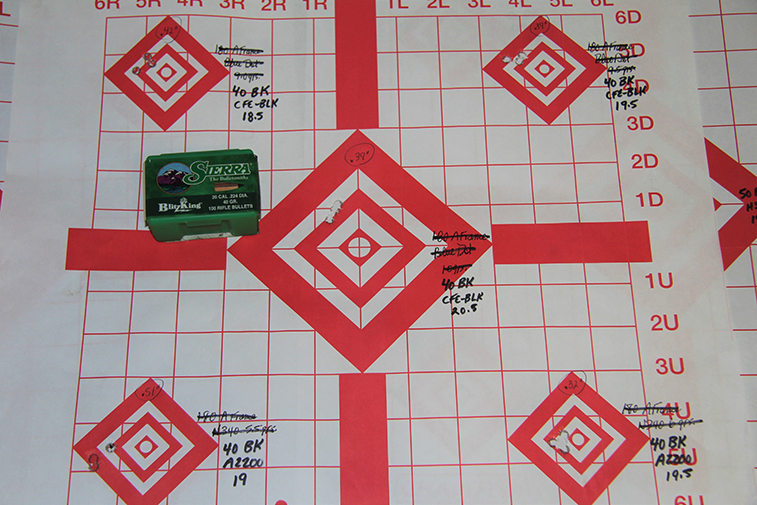
with Patrick’s new Oregunsmithing custom .221 Remington Fireball rifle.
The bullet produced groups measuring from .32 to .51 inch with several powders.
Bullets covered the gamut between 35 and 50 grains. Hornady’s 35-grain NTX (Non-Traditional eXpanding) is a flyweight nontoxic with a copper/tin matrix core that is California legal and destructive. The bullet includes a G1 ballistic coefficient (BC) of .177. Barnes’ 36-grain Varmint Grenade is another nontoxic option, a hollowpoint including a gilded copper jacket packed with a copper/tin mixture that lives up to its name. The long-for-weight bullet includes a .149 G1 BC. Berger’s 40-grain Flat Base Varmint is a longtime favorite, usually offering easy accuracy and explosive terminal performance. With a G1 BC of .151, they hold up well in breezy conditions. Sierra’s 40-grain BlitzKing is a poly-tipped varmint bullet offering reliable accuracy and a higher .196 G1 BC for longer shots in a breeze. Sierra’s 45-grain Varminter Soft Point Hornet was substituted for the Varminter SPT I’ve used extensively in the Fireball, as all my SPTs had been exhausted and replacements were impossible to find. During sight-in using 788 varmint ammunition, the 45-grain SPT seated over a compressed charge of 19.5 grains of Alliant Reloder 7 printed .29 inch at 3,421 feet per second (fps) from the new rifle – instead of the .28 inch at 3,287 fps produced by the 788. The blunted Hornet design included a .121 G1 BC and should provide dismantling impacts on small varmints. Finally, Speer’s 50-grain TNT was included because I have so many and wanted to make some use of them. These aggressive hollowpoints include a .228 G1 BC and should deliver more thump for the coyotes I enjoy calling during winter months.