



.218 Bee Loads |
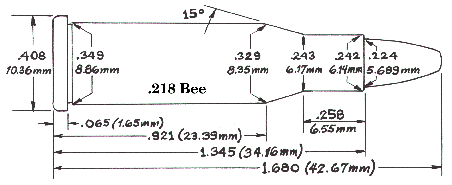 |
| Warning! Notes: Loads were tested in a Ruger No. 1 .218 Bee at 100 yards with a Redfield 10x scope mounted. Winchester-Western cases and CCI 400 primers used throughout. (Rifle Issue #178 - July, 1998) |
|
Cartridge History
.218 Bee Loads The .218 Bee Loads featured in Rifle Issue #178 – July, 1998 showcase what this cartridge can do when matched with modern powders, quality brass, and precise component selection. These loads were tested in a Ruger No. 1 rifle, scoped with a Redfield 10x at 100 yards, using Winchester-Western cases and CCI 400 primers. The data gives detailed insights into velocities, group performance, and optimal bullet and powder pairings for shooters who want to push past basic plinking loads. One standout load includes the 40-grain Hornady V-Max over Winchester W-680 powder, producing approximately 2,995 fps. Although the group size came in around 1.50 inches, this load is valued for its high velocity and clean burn. Another load with a 45-grain Sierra Spitzer bullet over Alliant RL-7 reached about 2,818 fps, showing better group precision despite the slightly heavier projectile. Other loads such as the 45-grain Hornady Bee with Hodgdon H-322 and a 50-grain Remington hollow point with IMR-4227 (approx. 2,559 fps) show that the .218 Bee can balance velocity and accuracy across bullet weights. The data emphasizes seating depth, powder consistency, and case preparation. Many of the loads achieved the tightest groups when proper overall lengths were used: OALs of around 1.68 to 1.775 inches depending on bullet shape and weight. Rifles with heavier barrels and match-grade bullets benefited most from the higher velocities, though recoil remained mild thanks to the Bee’s modest powder charges. Fouling and barrel wear are noted as limiting factors, particularly with the lighter, hotter loads. Some vertical stringing was observed in the higher velocity loads, signaling that while maximum velocities are impressive, there are trade-offs in stability and group tightness. Overall, the precision potential of the .218 Bee shines when selecting loads that offer a balance—using powders that burn cleanly and bullets that stabilize well with the rifle’s twist rate. Source: Wolfe Publishing — Rifle Issue #178 – July, 1998 |
| Be Alert: Publisher cannot be responsible for errors in published load data. |
| Wt. | Bullet | Powder Manufacturer | Powder | Charge | Velocity (FPS) | |
| 40 | Hornady V-Max | Winchester | W-680 | Subscribe | 2,995 | |
| Remarks: OAL (inches): 1.765; group size (inches): 1.50; vertical stringing in all groups | ||||||
| 45 | Hornady Bee | Hodgdon | H-322 | Subscribe | 2,503 | |
| Remarks: OAL (inches): 1.630; group size (inches): 1.50 | ||||||
| 45 | Sierra spitzer | Alliant | RL-7 | Subscribe | 2,818 | |
| Remarks: OAL (inches): 1.750; group size (inches): 1.75 | ||||||
| 45 | Speer spitzer | Alliant | 2400 | Subscribe | 2,758 | |
| Remarks: OAL (inches): 1.680; group size (inches): 1.00; good group with light bullet | ||||||
| 50 | Remington HP | IMR | IMR-4227 | Subscribe | 2,559 | |
| Remarks: OAL (inches): 1.685; group size (inches): .75; great | ||||||
| 50 | Speer TNT | Hodgdon | H-322 | Subscribe | 2,554 | |
| Remarks: OAL (inches): 1.775; group size (inches): 1.75 | ||||||
| 50 | Hornady V-Max | Accurate | AAC-1680 | Subscribe | 2,407 | |
| Remarks: OAL (inches): 1.750; group size (inches): 1.25 | ||||||
| 50 | Hornady Spire Point | IMR | IMR-4227 | Subscribe | 2,612 | |
| Remarks: OAL (inches): 1.690; group size (inches): 1.25; higher velocity of all 50-grain bullets | ||||||