



.25-222 Copperhead (Handloader Issue #359) |
 |
| Warning! Load Notes: All loads were developed by John Wootters during the 1970s with a maximum calculated pressure of 44,000 psi. Remington .222 Remington cases were necked up to .25 caliber, and CCI 400 Small Rifle primers were used throughout. Velocities were obtained from a custom Sako L461 rifle featuring an 18?-inch barrel with a 1:14-inch twist. Velocity measurements were recorded using Oehler Model 10 and Model 20 digital chronographs equipped with silver-printed paper screens. Ambient testing temperatures ranged from 78 to 92 degrees Fahrenheit. |
|
Cartridge History
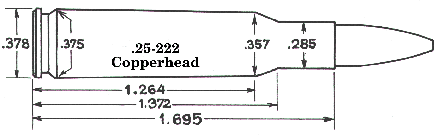
.25-222 Copperhead The .25-222 Copperhead is a classic American wildcat cartridge developed by necking the .222 Remington case up to accept .257-inch bullets. Emerging during the golden age of cartridge experimentation in the 1950s and 1960s, the Copperhead was created by handloaders seeking a compact, efficient quarter-bore cartridge capable of delivering excellent accuracy and useful field performance without the powder consumption and recoil associated with larger .25-caliber rounds. Although it never became a factory-standard offering, the .25-222 Copperhead earned a loyal following among varmint hunters, target shooters, and wildcat enthusiasts who appreciated its balance of efficiency and performance. The cartridge's parent case, the .222 Remington, was already renowned for exceptional accuracy and became one of the most influential cartridge designs of the twentieth century. Wildcatters quickly recognized its potential as a foundation for numerous experimental cartridges. By expanding the neck to accommodate .257-inch bullets, they created a cartridge that retained the excellent feeding characteristics and inherent precision of the .222 Remington while providing access to the wide range of quarter-bore bullets available to reloaders. The result was a cartridge capable of handling both lightweight varmint bullets and heavier projectiles suitable for small to medium-sized game. One of the defining characteristics of the .25-222 Copperhead is its efficiency. With modest powder charges and a relatively small case capacity, the cartridge can produce impressive velocities while generating very little recoil or muzzle blast. This makes it particularly enjoyable for extended shooting sessions and ideal for shooters who value precision over raw power. Lightweight bullets can be driven at speeds suitable for varmint hunting, while heavier bullets provide excellent performance on predators and similar-sized game animals. The cartridge's mild manners also contribute to excellent shooter comfort and the ability to observe bullet impact through the scope. Accuracy has always been one of the Copperhead's strongest selling points. Built upon the highly respected .222 Remington case, the cartridge is capable of outstanding precision when paired with quality bullets and carefully developed handloads. Many shooters found that the combination of efficient powder combustion and moderate operating pressures resulted in excellent consistency. This accuracy, combined with the broad selection of .25-caliber bullets available to handloaders, allowed the cartridge to excel in a variety of shooting applications. Despite its many positive attributes, the .25-222 Copperhead remained a niche cartridge. The introduction of factory offerings such as the .223 Remington, .22-250 Remington, .243 Winchester, and later numerous modern small-bore cartridges limited its commercial appeal. Nevertheless, it continued to attract dedicated handloaders who appreciated the satisfaction of shooting a unique and highly efficient wildcat. Brass could be formed easily from readily available .222 Remington cases, making it relatively straightforward to support for those willing to reload. Today, the .25-222 Copperhead remains an interesting piece of wildcat cartridge history. It exemplifies the creativity of mid-century American experimenters who sought practical solutions through careful cartridge design rather than simply increasing case capacity. While it may be overshadowed by modern factory offerings, the Copperhead continues to hold a special place among enthusiasts who appreciate efficient quarter-bore cartridges and the rich tradition of American wildcatting. |
| Be Alert: Publisher cannot be responsible for errors in published load data. |
| Wt. | Bullet | Powder Manufacturer | Powder | Charge | Velocity (FPS) | |
| 60 | Speer spire point | IMR | IMR-4198 | Subscribe | 2940 | |
| Remarks: | ||||||
| 60 | Speer spire point | Hodgdon | H-4227 | Subscribe | 2955 | |
| Remarks: | ||||||
| 73 | Lyman 257463 | IMR | IMR-4198 | Subscribe | 2070 | |
| Remarks: | ||||||
| 73 | Lyman 257463 | Hodgdon | H-4227 | Subscribe | 13620 | |
| Remarks: | ||||||
| 73 | Lyman 257463 | Alliant | 2400 | Subscribe | 2070 | |
| Remarks: | ||||||
| 73 | Lyman 257463 | Alliant | Bullseye | Subscribe | 825 | |
| Remarks: | ||||||
| 75 | Hornady softpoint | IMR | IMR-4198 | Subscribe | 2765 | |
| Remarks: | ||||||
| 87 | Sierra Spitzer | IMR | IMR-4198 | Subscribe | 2590 | |
| Remarks: | ||||||
| 100 | Speer SP | Winchester | W-680BR | Subscribe | 2465 | |
| Remarks: | ||||||