



.256 Newton (from Reformed .30-06 Cases) |
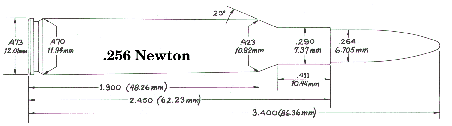 |
| Warning! Notes: Make certain case necks are thin enough for adequate clearance in the chamber or pressures will rise sharply. If in doubt, put one layer of cellophane tape on loaded necks and attempt to chamber. If the case doesn't chamber, necks probably need thinning. |
|
Cartridge History
.256 Newton (from Reformed .30-06 Cases) The .256 Newton is one of the more interesting early American high-velocity cartridges, developed by Charles Newton during the early twentieth century. Though its name suggests a .256-inch bullet, the cartridge actually uses a 6.5mm bullet, placing it in the same general bore class as several European cartridges that earned strong reputations for flat trajectory, mild recoil, and deep penetration. Newton’s goal was to create a modern sporting cartridge that offered impressive velocity for its time while still fitting into practical bolt-action rifles. The result was a cartridge that gained a small but loyal following among hunters and experimenters. Original .256 Newton ammunition and brass became difficult to obtain over time, which led many handloaders to form cases from more common parent brass. One practical method involved reforming .30-06 cases, taking advantage of the availability and strength of the .30-06 Springfield case. This process required careful resizing, trimming, and case preparation to produce usable .256 Newton brass. Because the cartridge was not as commercially common as more mainstream hunting rounds, this kind of case forming became an important part of keeping rifles chambered for the .256 Newton in use. When properly loaded, the .256 Newton can still offer useful field performance. Its 6.5mm bullets provide good sectional density, which helps penetration on medium game, while the cartridge’s velocity gives it a relatively flat trajectory for hunting at practical distances. Although it has been overshadowed by later 6.5mm cartridges, the .256 Newton remains historically important as an early example of American interest in small-bore, high-velocity sporting rounds. For handloaders, it also represents the kind of careful case-forming work that has long been part of keeping older and uncommon cartridges alive. |
| Be Alert: Publisher cannot be responsible for errors in published load data. |
| Wt. | Bullet | Powder Manufacturer | Powder | Charge | Velocity (FPS) | |
| 100 | JHP | IMR | IMR-3031 | Subscribe | 3,100 | |
| Remarks: energy (fp): 3,129 | ||||||
| 120 | JSP | IMR | IMR-4350 | Subscribe | 3,000 | |
| Remarks: energy (fp): 2,400 | ||||||
| 120 | JSP | IMR | IMR-4064 | Subscribe | 2,900 | |
| Remarks: energy (fp): 2,240 | ||||||
| 120 | JSP | IMR | IMR-4895 | Subscribe | 2,750 | |
| Remarks: energy (fp): 2,015 | ||||||
| 130 | JSP | IMR | IMR-3031 | Subscribe | 2,750 | |
| Remarks: energy (fp): 2,183 | ||||||
| 130 | JSP | IMR | IMR-4064 | Subscribe | 3,000 | |
| Remarks: energy (fp): 2,600 | ||||||
| 130 | JSP | IMR | IMR-4350 | Subscribe | 2,950 | |
| Remarks: energy (fp): 2,512 | ||||||
| 140 | JSP | IMR | IMR-4350 | Subscribe | 2,850 | |
| Remarks: energy (fp): 2,526 | ||||||
| 140 | JSP | IMR | IMR-4350 | Subscribe | 2,950 | |
| Remarks: energy (fp): 2,705 | ||||||
| 150 | JSP | IMR | IMR-4350 | Subscribe | 2,870 | |
| Remarks: energy (fp): 2,744 | ||||||
| 160 | JSP | IMR | IMR-4064 | Subscribe | 2,550 | |
| Remarks: energy (fp): 2,310 | ||||||