



.30 Carbine (Hodgdon Pistol Data) |
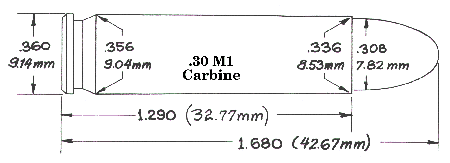 |
| Warning! Notes: case: Winchester; barrel length: 7"; twist: 1:20"; trim length: 1.286"; primer: CCI 400; bullet diam.: .308"; NEVER EXCEED MAXIMUM LOADS |
|
Cartridge History
.30 Carbine (Hodgdon Pistol Data) Although the .30 Carbine is most commonly associated with the M1 Carbine rifle, the cartridge has also found a place in certain handgun platforms over the years. Most notably, Ruger chambered its Blackhawk revolver in .30 Carbine, introducing shooters to a completely different side of the cartridge. When fired from a revolver, the .30 Carbine produces extremely high muzzle blast and sharp report due to its rifle-oriented powder charges being discharged from a much shorter barrel. Even so, the cartridge delivers impressive velocity and flat trajectory compared to many traditional handgun cartridges. Originally developed during World War II for the U.S. military’s M1 Carbine, the .30 Carbine was intended to bridge the gap between pistols and full-power rifles. Using a straight-walled rimless case and typically loaded with 110-grain bullets, the cartridge became known for light recoil, reliable semi-automatic operation, and compact ammunition weight. In revolvers and specialty pistols, however, shooters often discovered that the cartridge behaved much differently, with louder muzzle blast and increased flash becoming defining characteristics. Hodgdon pistol load data for the .30 Carbine generally focuses on powders capable of maintaining proper pressure and velocity while functioning safely in handgun-length barrels. Powders such as H110 and Winchester 296 remain especially popular choices due to their ability to provide strong performance with standard bullet weights. Because the .30 Carbine operates at relatively high pressures for its size, careful handloading practices are important, particularly when working with shorter barrels where incomplete powder burn can affect both performance and muzzle flash. Despite its unconventional nature in handguns, the .30 Carbine remains an interesting and enjoyable cartridge for revolver shooters and handloaders alike. Its combination of high velocity, flat trajectory, and historical background continues to attract enthusiasts who appreciate unique firearm platforms and cartridges that stand apart from more traditional handgun offerings. |
| Be Alert: Publisher cannot be responsible for errors in published load data. |
| Wt. | Bullet | Powder Manufacturer | Powder | Charge | Velocity (FPS) | |
| 85 | Sierra RN | Hodgdon | H-4227 | Subscribe | 1643 | |
| Remarks: starting load; COL: 1.625"; 25,200 cup | ||||||
| 85 | Sierra RN | Hodgdon | H-4227 | Subscribe | 1745 | |
| Remarks: compressed load; maximum load; COL: 1.625"; 30,700 cup | ||||||
| 85 | Sierra RN | Hodgdon | H-110 | Subscribe | 1834 | |
| Remarks: starting load; COL: 1.625"; 26,000 cup | ||||||
| 85 | Sierra RN | Hodgdon | H-110 | Subscribe | 1966 | |
| Remarks: maximum load; COL: 1.625"; 34,800 cup | ||||||
| 100 | Speer SP | Hodgdon | H-4227 | Subscribe | 1503 | |
| Remarks: starting load; COL: 1.625"; 28,900 cup | ||||||
| 100 | Speer SP | Hodgdon | H-4227 | Subscribe | 1621 | |
| Remarks: compressed load; maximum load; COL: 1.625"; 33,600 cup | ||||||
| 100 | Speer SP | Hodgdon | H-110 | Subscribe | 1660 | |
| Remarks: starting load; COL: 1.625"; 28,200 cup | ||||||
| 100 | Speer SP | Hodgdon | H-110 | Subscribe | 1762 | |
| Remarks: maximum load; COL: 1.625"; 36,100 cup | ||||||
| 110 | Hornady JRN | Hodgdon | H-4227 | Subscribe | 1461 | |
| Remarks: starting load; COL: 1.680"; 30,100 cup | ||||||
| 110 | Hornady JRN | Hodgdon | H-4227 | Subscribe | 1602 | |
| Remarks: compressed load; maximum load; COL: 1.680"; 38,800 cup | ||||||
| 110 | Hornady JRN | Hodgdon | H-110 | Subscribe | 1605 | |
| Remarks: starting load; COL: 1.680"; 32,000 cup | ||||||
| 110 | Hornady JRN | Hodgdon | H-110 | Subscribe | 1685 | |
| Remarks: maximum load; COL: 1.680"; 36,500 cup | ||||||