



.30 Carbine (IMR Data) |
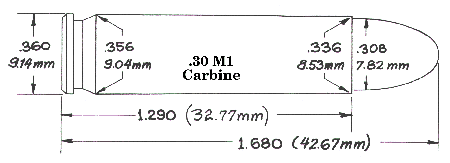 |
| Warning! Notes: case: Remington; bbl: 18"; pr: Remington 6 1/2; NEVER exceed loads listed |
|
Cartridge History
.30 Carbine (IMR Data) The .30 Carbine remains one of the most recognizable American military cartridges ever developed, originally created during World War II for the lightweight M1 Carbine rifle. Designed to provide greater effectiveness than a standard sidearm while remaining lighter and more compact than full-power infantry rifles, the cartridge quickly earned widespread military use. Its low recoil, reliable semi-automatic function, and compact ammunition weight made it especially useful for support troops, vehicle crews, and officers who needed a practical defensive firearm without the burden of a larger battle rifle. Built around a straight-walled rimless case and commonly loaded with 110-grain bullets, the .30 Carbine delivers velocities near 2,000 feet per second from standard rifle barrels. This gives the cartridge noticeably flatter trajectory and greater energy than most traditional handgun cartridges while still maintaining very manageable recoil. Civilian shooters later embraced the cartridge through surplus M1 Carbines, helping establish its long-standing popularity for recreational shooting, collecting, and handloading. IMR load data for the .30 Carbine has long included powders suited to the cartridge’s relatively small case capacity and semi-automatic operating system. Powders such as IMR-4227 became particularly popular among handloaders due to their ability to produce reliable cycling, consistent velocities, and good accuracy. Because the M1 Carbine relies on proper gas pressure for reliable function, careful powder selection plays an important role in achieving dependable performance. Handloaders also pay close attention to cartridge overall length and crimp consistency to ensure reliable feeding through detachable box magazines. Even decades after its military introduction, the .30 Carbine continues to hold a unique place among American cartridges. Its historical connection to the M1 Carbine, combined with light recoil and enjoyable shooting characteristics, keeps it relevant among modern enthusiasts. Whether used in original military rifles, commercial reproductions, or specialty handguns, the cartridge remains an enduring example of practical mid-century firearm design. |
| Be Alert: Publisher cannot be responsible for errors in published load data. |
| Wt. | Bullet | Powder Manufacturer | Powder | Charge | Velocity (FPS) | |
| 100 | Hornady Short Jacket | IMR | IMR-4227 | Subscribe | 2,005 | |
| Remarks: 40,000 cup; compressed powder charge | ||||||
| 100 | Hornady Short Jacket | IMR | SR-4759 | Subscribe | 1,575 | |
| Remarks: 23,700 cup; compressed powder charge | ||||||
| 110 | Hornady Round Nose | IMR | IMR-4227 | Subscribe | 1,900 | |
| Remarks: 40,000 cup; compressed powder charge | ||||||
| 110 | Hornady Round Nose | IMR | SR-4759 | Subscribe | 1,545 | |
| Remarks: 26,100 cup; compressed powder charge | ||||||