



.30 Carbine (Winchester Rifle Data) |
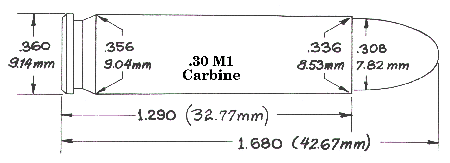 |
| Warning! Notes: case: Winchester; BBL: 20"; PR: CCI 400; NEVER exceed loads listed |
|
Cartridge History
.30 Carbine (Winchester Rifle Data) The .30 Carbine was developed during World War II to provide American troops with a lightweight cartridge that offered greater effectiveness than a handgun while remaining easier to carry and control than a full-power battle rifle. Winchester played a major role in the cartridge’s development alongside the M1 Carbine rifle, helping create one of the most recognizable military firearm combinations of the twentieth century. The cartridge quickly became popular due to its light recoil, compact size, and reliable performance in semi-automatic carbines. Using a straight-walled rimless case and commonly loaded with 110-grain bullets, the .30 Carbine produces moderate recoil and relatively high velocity from rifle-length barrels. Standard loads generally reach velocities near 2,000 feet per second from the M1 Carbine’s 18-inch barrel, giving the cartridge noticeably flatter trajectory and greater energy than traditional handgun cartridges. Its lightweight ammunition also allowed soldiers to carry significantly more rounds compared to heavier service rifle cartridges of the era. Winchester rifle data for the .30 Carbine focuses on maintaining safe pressure levels and reliable cycling in semi-automatic carbines. Powders such as H110, Winchester 296, and similar medium-burning propellants have long been favored because they produce dependable function and consistent velocities within the cartridge’s relatively small case capacity. Since the cartridge headspaces on the case mouth, careful case trimming and proper cartridge overall length are important for maintaining reliable feeding and extraction. Outside military service, the .30 Carbine became extremely popular among civilian shooters through surplus rifles and commercial reproductions. Its mild recoil and enjoyable shooting characteristics continue to attract collectors, recreational shooters, and handloaders alike. Even decades after its introduction, the cartridge remains closely tied to the historic M1 Carbine platform and continues to hold an important place in American firearms history. |
| Be Alert: Publisher cannot be responsible for errors in published load data. |
| Wt. | Bullet | Powder Manufacturer | Powder | Charge | Velocity (FPS) | |
| 80 | Sierra Round Nose | Winchester | W-296 | Subscribe | 2,458 | |
| Remarks: col: 1.625"; 34,800 cup | ||||||
| 85 | Sierra Round Nose | Winchester | W-296 | Subscribe | 2293 | |
| Remarks: starting load; col: 1.625"; 26,000 cup | ||||||
| 85 | Sierra Round Nose | Winchester | W-296 | Subscribe | 2458 | |
| Remarks: maximum load; col: 1.625"; 34,800 cup | ||||||
| 100 | Speer SP | Winchester | W-296 | Subscribe | 2,202 | |
| Remarks: col: 1.625"; 36,100 cup | ||||||
| 110 | Hornady JRN | Winchester | W-296 | Subscribe | 2,106 | |
| Remarks: col: 1.680"; 36,500 cup | ||||||