



.300 Holland & Holland Magnum (Handloader Issue #359) |
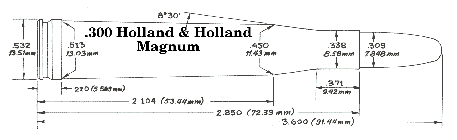 |
| Warning! Load Notes: A custom rifle built by Lex Webernick of Rifles, Inc., on a blueprinted Remington 700 action was used to develop all loads. The rifle featured a 26-inch Lilja 3-groove barrel with a 1:10-inch twist. Nosler cases and Federal GM215M primers were used throughout, and a Redding die set with a Competition bullet seating die was utilized for handloading. Velocities were recorded at 12 feet using an Oehler Model 33 chronograph, with nine rounds fired for each load. Ambient temperature during testing was 82 degrees Fahrenheit. All listed powder charges represent maximum or near-maximum loads and should be reduced by 10 percent when developing starting loads for other rifles. Accuracy was determined by averaging two separate three-shot groups, allowing the barrel to cool between each group. |
|
Cartridge History
.300 Holland & Holland Magnum (Handloader Issue #359) The .300 Holland & Holland Magnum is one of the most influential big-game cartridges ever developed and remains a benchmark by which many modern .30-caliber magnums are measured. Introduced by the famed British gunmaker Holland & Holland in 1925, the cartridge was originally known as the .300 Super Thirty. It was designed by necking down the proven .375 H&H Magnum case to accept .308-inch bullets, creating a flat-shooting cartridge capable of delivering excellent long-range performance for hunting large game. According to Layne Simpson's feature article in Handloader Issue #359, 2025 marked the cartridge's 100th anniversary, making it one of the few magnum rifle cartridges to remain relevant for an entire century. :contentReference[oaicite:0]{index=0} One of the defining characteristics of the .300 H&H Magnum is its distinctive tapered case and gentle shoulder angle. While unusual by modern standards, this design was largely influenced by the use of cordite propellant during the early twentieth century. The long strands of cordite required a lengthy case shape, and the resulting cartridge became renowned for exceptionally smooth feeding and extraction in bolt-action rifles. Hunters operating in harsh conditions quickly appreciated its reliability, and the cartridge gained a reputation for flawless performance on dangerous and non-dangerous game alike. The .300 H&H Magnum achieved widespread popularity in North America when Winchester chambered it in the Model 70 rifle. During the mid-twentieth century, it became one of the premier choices for elk, moose, sheep, and large bear hunting. Its combination of velocity, accuracy, and manageable recoil made it a favorite among experienced hunters. Long before the arrival of the .300 Winchester Magnum and various short-magnum cartridges, the .300 H&H was considered the gold standard for long-range .30-caliber performance. Ballistically, the cartridge remains highly capable even by modern standards. Traditional factory loads commonly propelled 180-grain bullets at nearly 3,000 feet per second, providing excellent energy retention and flat trajectories. Handloaders have long appreciated the cartridge's generous powder capacity and ability to perform well with a wide range of bullet weights. Modern premium bullets have only enhanced its effectiveness, allowing hunters to confidently pursue virtually any game animal in North America and much of the world. Although eventually overshadowed by the shorter and more compact .300 Winchester Magnum, the .300 H&H Magnum continues to enjoy a loyal following among hunters, collectors, and rifle enthusiasts. Many shooters consider it one of the most elegant sporting cartridges ever designed, combining excellent field performance with a rich historical pedigree. Its influence can be seen in nearly every belted magnum cartridge that followed, and its century-long record of success speaks for itself. For those who appreciate classic sporting cartridges, the .300 Holland & Holland Magnum remains a timeless choice that continues to earn respect in hunting camps around the world. |
| Be Alert: Publisher cannot be responsible for errors in published load data. |
| Wt. | Bullet | Powder Manufacturer | Powder | Charge | Velocity (FPS) | |
| 150 | Nosler E-Tip | Hodgdon | H-4831 | Subscribe | 3269 | |
| Remarks: 100 yard group (inches): .97; COAL (inches): 3.560 | ||||||
| 155 | Lehigh Defense TME | Vihtavuori | VV-N550 | Subscribe | 3255 | |
| Remarks: 100 yard group (inches): .84; COAL (inches): 3.565 | ||||||
| 165 | Hornady GMX | Vihtavuori | VV-N165 | Subscribe | 3118 | |
| Remarks: 100 yard group (inches): .92; COAL (inches): 3.580 | ||||||
| 165 | Swift A-Frame | Vihtavuori | VV-N165 | Subscribe | 3134 | |
| Remarks: 100 yard group (inches): .90; COAL (inches): 3.560 | ||||||
| 180 | Nosler AccuBond | Alliant | RL-23 | Subscribe | 3089 | |
| Remarks: 100 yard group (inches): .54; COAL (inches): 3.590 | ||||||
| 180 | Swift Scirrocco II | IMR | IMR-7828ssc | Subscribe | 3056 | |
| Remarks: 100 yard group (inches): .65; COAL (inches): 3.585 | ||||||
| 200 | Barnes TSX Flat Base | Accurate | MAGPRO | Subscribe | 2849 | |
| Remarks: 100 yard group (inches): 1.12; COAL (inches): 3.510 | ||||||
| 200 | Swift A-Frame | Alliant | RL-25 | Subscribe | 3011 | |
| Remarks: 100 yard group (inches): 1.04; COAL (inches): 3.575 | ||||||
| 210 | Berger VLD Hunting | Vihtavuori | VV-N560 | Subscribe | 2851 | |
| Remarks: 100 yard group (inches): .60; COAL (inches): 3.575 | ||||||
| 220 | Nosler Partition | Alliant | RL-26 | Subscribe | 2734 | |
| Remarks: 100 yard group (inches): 1.20; COAL (inches): 3.610 | ||||||
| 220 | Northern Precision VLD | Alliant | RL-26 | Subscribe | 2695 | |
| Remarks: 100 yard group (inches): 1.17; COAL (inches): 3.610 | ||||||