



.32-40 (for Single Shots) (Handloader Issue #359) |
 |
| Warning! Load Notes: All loads were tested in a Stevens Model 51 built on a No. 44 action with a 30-inch barrel featuring a 1:16-inch rifling twist. The rifle was equipped with Shaver tang and front sights. Federal Gold Medal 210M Large Rifle Match primers and Quality Cartridge cases were used throughout load development. |
|
Cartridge History
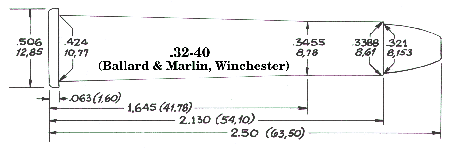
.32-40 for Single Shots The .32-40 is one of the most celebrated target and sporting cartridges of the late nineteenth century. Introduced in 1884 as the .32-40 Ballard, it was originally developed for single-shot rifles and quickly gained a reputation for exceptional accuracy, mild recoil, and versatility. Designed during the golden age of American target shooting, the cartridge became a favorite among competitors, hunters, and rifle cranks who appreciated precision above all else. While many cartridges from the black-powder era faded into obscurity, the .32-40 has survived due to its outstanding performance in classic single-shot rifles and its enduring appeal among handloaders. The cartridge was initially chambered in Ballard rifles before being adopted by Winchester, Stevens, Remington, and other manufacturers, becoming one of the dominant target cartridges of its era. :contentReference[oaicite:0]{index=0} Originally loaded with a .321-inch bullet weighing approximately 165 grains over 40 grains of black powder, the .32-40 delivered excellent accuracy with surprisingly mild recoil. Competitive shooters soon discovered that its moderate velocity and efficient bullet design made it capable of remarkable precision at distances extending well beyond 200 yards. The cartridge became a fixture in target matches throughout the United States and was widely regarded as one of the finest offhand shooting cartridges ever developed. Many of the legendary marksmen of the period relied on the .32-40 in single-shot rifles, particularly in rifles such as the Winchester High Wall, Ballard, Stevens 44½, and Remington Rolling Block. :contentReference[oaicite:1]{index=1} Single-shot rifles are particularly well suited to the .32-40 because they allow the use of longer bullets and specialized seating techniques that are not practical in repeating rifles. Competitive shooters frequently employed breech-seated cast bullets, a practice that helped maximize accuracy by aligning the projectile perfectly with the bore before firing. This approach, combined with carefully crafted handloads, allowed the .32-40 to achieve levels of precision that were extraordinary for its time. Even today, many Schuetzen and black-powder cartridge rifle competitors continue to favor the cartridge because of its forgiving nature and exceptional accuracy potential. :contentReference[oaicite:2]{index=2} Although smokeless cartridges such as the .30-30 Winchester eventually eclipsed the .32-40 in popularity, the cartridge remained respected by knowledgeable shooters. Hunters appreciated its effectiveness on deer-sized game, while target shooters continued to exploit its accuracy advantages. Modern handloaders benefit from a wide variety of suitable cast and jacketed bullets, along with powders capable of duplicating traditional black-powder ballistics or producing mild smokeless loads tailored for vintage rifles. Care must be taken with older firearms, however, as many original rifles were manufactured more than a century ago and should only be fired with appropriate pressure levels. Today, the .32-40 remains one of the most beloved cartridges among enthusiasts of classic single-shot rifles. Its combination of historical significance, remarkable accuracy, and pleasant shooting characteristics has ensured its continued use long after many of its contemporaries disappeared. Whether used in a restored antique rifle or a modern reproduction, the .32-40 continues to demonstrate why it earned its reputation as one of America's greatest target cartridges. |
| Be Alert: Publisher cannot be responsible for errors in published load data. |
| Wt. | Bullet | Powder Manufacturer | Powder | Charge | Velocity (FPS) | |
| 165 | Missouri Bullet Company Cast | IMR | IMR-4198 | Subscribe | 1520 | |
| Remarks: COAL (inches): 2.5; extreme spread (fps): 67 | ||||||
| 165 | Buffalo Arms 319247 | IMR | IMR-4227 | Subscribe | 1536 | |
| Remarks: COAL (inches): 2.5; extreme spread (fps): 34 | ||||||
| 165 | Lyman 319247 | Alliant | Unique | Subscribe | 1220 | |
| Remarks: COAL (inches): 2.5; extreme spread (fps): 11 | ||||||
| 170 | Lightning Ammo Cast | Accurate | AAC-5744 | Subscribe | 1431 | |
| Remarks: COAL (inches): 2.5; extreme spread (fps): 46 | ||||||
| 186 | Ideal 319201 (Loverin) | IMR | IMR-4227 | Subscribe | 1410 | |
| Remarks: COAL (inches): 2.5; extreme spread (fps): 25 | ||||||