



.33 WCF / .33 Winchester Loads |
 |
| Warning! |
|
Cartridge History
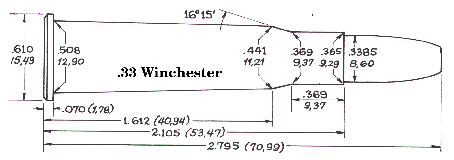
.33 WCF / .33 Winchester The .33 Winchester Center Fire (.33 WCF), often referred to simply as the .33 Winchester, was introduced in 1902 for use in the Winchester Model 1886 lever-action rifle. Designed as a more powerful alternative to earlier black powder-era cartridges, the .33 WCF was intended to deliver improved performance for medium to large game hunting, particularly in North American conditions where deeper penetration and greater energy were required. The cartridge is based on a necked-down version of the .45-70 Government case, utilizing a .338-inch diameter bullet rather than the more common .308 or .358 projectiles of the time. Early factory loads typically featured a 200-grain bullet propelled at velocities approaching 2,200 feet per second, which was considered impressive performance for the era. This gave the .33 WCF a flatter trajectory and greater striking energy compared to many of its contemporaries, making it well-suited for hunting deer, elk, and similar game. Handloading the .33 Winchester requires careful attention to component selection due to its age and the rifles typically chambered for it. Most original firearms were built with metallurgy standards of the early 20th century, so modern reloaders often choose to operate at moderate pressure levels to preserve both safety and firearm longevity. Suitable powders generally fall within the medium burn-rate range, providing efficient case fill and consistent ignition without exceeding safe pressure thresholds. Bullet selection for the .33 WCF has historically been somewhat limited, though modern .338-caliber bullets have expanded the options available to handloaders. Lighter bullets can be used to approximate traditional factory performance, while slightly heavier projectiles may be selected for increased penetration. Seating depth and overall cartridge length must be considered carefully, particularly when loading for lever-action rifles where reliable feeding is essential. Despite being largely obsolete in modern factory production, the .33 Winchester remains of interest to collectors, enthusiasts, and hunters who appreciate classic lever-action cartridges. With properly developed handloads, it continues to offer effective performance in the field while preserving its historical character. Its place in cartridge development represents a transitional period between black powder designs and the early smokeless powder era, highlighting the evolution of hunting cartridges in the United States. Source: Wolfe Publishing |
| Be Alert: Publisher cannot be responsible for errors in published load data. |
| Wt. | Bullet | Powder Manufacturer | Powder | Charge | Velocity (FPS) | |
| 200 | LBT (lead flatnose) | IMR | IMR-3031 | Subscribe | 1,960 | |
| Remarks: cast bullet | ||||||
| 200 | Hornady flatnose | IMR | IMR-3031 | Subscribe | 2,090 | |
| Remarks: accuracy | ||||||
| 200 | Hornady flatnose | Hodgdon | H-4895 | Subscribe | 2,200 | |
| Remarks: high velocity | ||||||