



.470 Nitro Express / .470 NE (A-Square Data) |
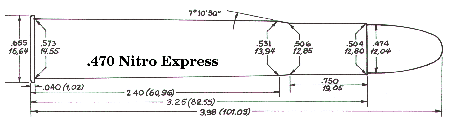 |
| Warning! Notes: barrel length: 26"; primer: CCI 250; trim to length: 3.240"; powder compression: yes, with slow burning powders; crimp: yes, roll crimp of .008" to .010"; other: light compression helps ignition; bullet diameter: .475" |
|
Cartridge History
.470 Nitro Express / .470 N.E. (A-Square Data) The .470 Nitro Express is one of the most enduring and widely respected dangerous-game cartridges ever developed, originally introduced in 1907 by Joseph Lang during the golden era of British double rifles. It was created as a response to restrictions on .450-caliber cartridges within British colonies, offering comparable performance while remaining legally acceptable for use throughout Africa and India. Over time, the .470 Nitro Express became a benchmark for dangerous-game cartridges, combining heavy bullet weight, moderate velocity and dependable function in break-action rifles. The cartridge is built on a rimmed case derived from the .500 Nitro Express, necked down to accept a .474-inch bullet. This design ensures reliable extraction and consistent performance in double rifles, where mechanical simplicity and immediate follow-up shots are essential. A-Square data reflects the traditional loading standards that have defined the cartridge for over a century, typically featuring a 500-grain bullet at approximately 2,100 to 2,150 feet per second. These ballistics produce energy levels exceeding 5,000 foot-pounds and emphasize controlled pressure and regulation over maximum velocity, preserving the performance characteristics required for properly regulated double rifles. Within A-Square’s Dangerous Game Cartridge (DGC) philosophy, the .470 Nitro Express represents a classic example of balanced stopping power and practical field performance. The cartridge is designed to deliver deep, straight-line penetration through heavy muscle and bone, making it highly effective against large and potentially dangerous animals such as Cape buffalo and elephant. Bullet selection plays a critical role, with non-expanding solid projectiles favored for maximum penetration and controlled-expansion softpoints used where increased tissue disruption is desired. Recoil is significant but generally manageable within the context of large Nitro Express cartridges, contributing to the .470’s long-standing popularity among professional hunters. Rifles chambered for the cartridge are typically built with careful attention to weight, stock design and regulation to ensure reliable and accurate performance. Unlike modern bolt-action magnum cartridges, the .470 Nitro Express is most commonly associated with double rifles, where its rimmed case and moderate pressures allow for smooth extraction and consistent operation under demanding conditions. Although many modern cartridges have attempted to replicate or exceed its performance, the .470 Nitro Express remains a standard by which dangerous-game cartridges are measured. As reflected in A-Square load data, it continues to embody the principles of reliability, balance and decisive stopping power that have defined its reputation for more than a century. Source: A-Square Load Data |
| Be Alert: Publisher cannot be responsible for errors in published load data. |
| Wt. | Bullet | Powder Manufacturer | Powder | Charge | Velocity (FPS) | |
| 500 | A-Square Monolithic Solid | Hodgdon | H-4831 | Subscribe | 2,002 | |
| Remarks: 27,300 psi | ||||||
| 500 | A-Square Monolithic Solid | Hodgdon | H-4831 | Subscribe | 2,076 | |
| Remarks: 34,100 psi | ||||||
| 500 | A-Square Monolithic Solid | Hodgdon | H-4831 | Subscribe | 2,075 | |
| Remarks: 32,600 psi | ||||||
| 500 | A-Square Monolithic Solid | Hodgdon | H-4831 | Subscribe | 2,167 | |
| Remarks: 36,100 psi | ||||||
| 500 | A-Square Monolithic Solid | IMR | IMR-4831 | Subscribe | 2,045 | |
| Remarks: 30,200 psi | ||||||
| 500 | A-Square Monolithic Solid | IMR | IMR-4831 | Subscribe | 2,107 | |
| Remarks: 33,500 psi | ||||||
| 500 | A-Square Monolithic Solid | IMR | IMR-4831 | Subscribe | 2,158 | |
| Remarks: 37,000 psi | ||||||
| 500 | A-Square Monolithic Solid | Alliant | RL-15 | Subscribe | 2,113 | |
| Remarks: 40,000 psi; this load exceeds allowable maximum average pressure | ||||||
| 500 | A-Square Monolithic Solid | Alliant | RL-15 | Subscribe | 2,162 | |
| Remarks: 42,900 psi; this load exceeds allowable maximum average pressure | ||||||
| 500 | A-Square Monolithic Solid | IMR | IMR-7828 | Subscribe | 2,070 | |
| Remarks: 35,400 psi | ||||||
| 500 | A-Square Monolithic Solid | IMR | IMR-7828 | Subscribe | 2,112 | |
| Remarks: 37,700 psi | ||||||
| 500 | A-Square Monolithic Solid | Alliant | RL-19 | Subscribe | 2,052 | |
| Remarks: 31,500 psi | ||||||
| 500 | A-Square Monolithic Solid | Alliant | RL-19 | Subscribe | 2,087 | |
| Remarks: 32,700 psi | ||||||
| 500 | A-Square Monolithic Solid | Alliant | RL-19 | Subscribe | 2,170 | |
| Remarks: 37,900 psi | ||||||
| 500 | A-Square Monolithic Solid | Alliant | RL-19 | Subscribe | 2,248 | |
| Remarks: 42,000 psi; this load exceeds allowable maximum average pressure | ||||||
| 500 | A-Square Monolithic Solid | Alliant | RL-22 | Subscribe | 1,978 | |
| Remarks: 31,200 psi | ||||||
| 500 | A-Square Monolithic Solid | Alliant | RL-22 | Subscribe | 2,105 | |
| Remarks: 37,400 psi | ||||||
| 500 | A-Square Monolithic Solid | Alliant | RL-22 | Subscribe | 2,188 | |
| Remarks: 41,900 psi; this load exceeds allowable maximum average pressure | ||||||