



.470 Nitro Express / .470 NE (Alliant Data 2011) |
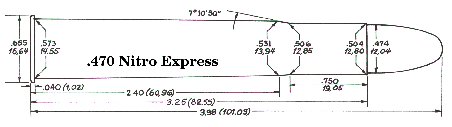 |
| Warning! Notes: case: Norma; minimum OAL (inches): 3.9; Bbl length: 24; primer: Fed 215 |
|
Cartridge History
.470 Nitro Express / .470 N.E. (Alliant Data 2011) The .470 Nitro Express remains one of the most historically significant and widely used dangerous-game cartridges, originally introduced in 1907 by Joseph Lang during the golden age of British sporting arms. Developed as an alternative to the .450 Nitro Express due to colonial restrictions, it quickly gained acceptance for its ability to deliver consistent and reliable stopping power on the largest game. More than a century later, the cartridge continues to serve as a benchmark for performance in double rifles, with modern load data—such as that published by Alliant in 2011—maintaining the original balance of power, pressure and reliability. The cartridge utilizes a rimmed case derived from the .500 Nitro Express, necked down to accept a .474-inch bullet. This configuration ensures dependable extraction and ejection in break-action rifles, where mechanical simplicity and rapid follow-up shots are essential. Alliant’s 2011 data adheres closely to traditional performance standards, typically featuring a 500-grain bullet driven at approximately 2,100 to 2,150 feet per second. These ballistics generate energy levels exceeding 5,000 foot-pounds while maintaining pressures appropriate for safe operation in both vintage and modern double rifles. The .470 Nitro Express is specifically intended for use on dangerous game, including elephant and Cape buffalo, where deep penetration and immediate stopping capability are critical. Bullet construction plays a key role in achieving this performance. Solid bullets are commonly used when maximum penetration is required, particularly for large, heavy-boned animals, while softpoint or controlled-expansion bullets are suitable for situations where increased tissue damage is desired. The moderate velocity of the cartridge contributes to reliable bullet performance and straight-line penetration, even through dense muscle and bone. Recoil is substantial, as expected from a cartridge of this class, but it is generally regarded as manageable when compared to larger Nitro Express rounds. Rifles chambered in .470 Nitro Express are typically designed with careful attention to weight, stock geometry and regulation to ensure effective handling and accuracy. The cartridge’s enduring popularity is due in part to this balance, allowing it to deliver significant power without excessive recoil relative to its peers. Despite the introduction of modern magnum cartridges for bolt-action rifles, the .470 Nitro Express continues to hold a prominent place in dangerous-game hunting. As reflected in Alliant’s 2011 load data, it remains true to its original design principles—providing reliable, controlled and effective performance in a cartridge that has proven itself over more than a century of use in the field. Source: Alliant Load Data (2011) |
| Be Alert: Publisher cannot be responsible for errors in published load data. |
| Wt. | Bullet | Powder Manufacturer | Powder | Charge | Velocity (FPS) | |
| 500 | Speer TBBC SP | Alliant | RL-19 | Subscribe | 2244 | |
| Remarks: | ||||||
| 500 | Speer TBBC SP | Alliant | RL-22 | Subscribe | 2234 | |
| Remarks: | ||||||