



.470 Nitro Express / .470 NE (Barnes Reloading Manual #4) |
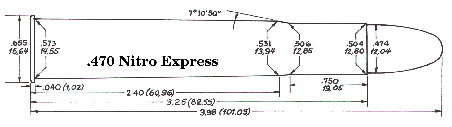 |
| Warning! Notes: case: Norma; case trim length: 3.240"; twist rate: 1:16"; primer: Fed GM215M; barrel length: 24"; barrel: PacNor; COAL: 3.980"; maximum loads should be used with caution; NOTE: Recommend crimping into front cannelure groove. Rifles with varying bore and groove diameters have been chambered for this cartridge before SAAMI & CIP standardized the specs. Barnes' .470 NE bullets are designed for modern firearms in good conditions built to current specs. If in doubt, contact the firearm manufacturer or a competent gunsmith to ensure your rifle is safe to use with modern loads. |
|
Cartridge History
.470 Nitro Express / .470 N.E. (Barnes Reloading Manual #4) The .470 Nitro Express stands as one of the most enduring dangerous-game cartridges, originally introduced in 1907 by Joseph Lang during the height of British sporting rifle development. Created as an alternative to the .450 Nitro Express due to colonial restrictions, it quickly proved itself as a highly effective cartridge for use on large and dangerous animals. Over time, it became one of the most widely trusted calibers among professional hunters, valued for its balance of power, reliability and practical performance in double rifles. Built on a rimmed case derived from the .500 Nitro Express, the cartridge is necked down to accept a .474-inch bullet. This design ensures dependable extraction and consistent operation in break-action rifles, where reliability is critical. Data presented in Barnes Reloading Manual No. 4 follows traditional loading specifications, typically utilizing a 500-grain bullet at velocities near 2,100 to 2,150 feet per second. These performance levels generate energy in excess of 5,000 foot-pounds while maintaining pressures appropriate for both modern and vintage rifles, preserving safe and consistent operation. Barnes places particular emphasis on bullet performance in the .470 Nitro Express, offering projectiles designed to maintain structural integrity while delivering effective terminal results. Solid bullets are preferred when maximum penetration is required, especially for elephant and similarly large game, while Barnes’ controlled-expansion designs provide reliable expansion and high weight retention for use on buffalo and other thick-skinned animals. The cartridge’s moderate velocity supports predictable bullet behavior, promoting straight-line penetration and minimizing excessive deformation. Recoil is substantial but remains manageable within its class, contributing to the cartridge’s long-standing reputation as a practical and effective stopping round. Rifles chambered in .470 Nitro Express are typically double rifles that are carefully regulated to ensure both barrels deliver consistent point of impact. Proper rifle weight and stock design are essential to handling the cartridge effectively, particularly in close-range encounters where quick follow-up shots may be required. Despite the development of modern high-velocity cartridges for bolt-action rifles, the .470 Nitro Express continues to hold a respected place in dangerous-game hunting. As reflected in Barnes Reloading Manual No. 4, it remains a cartridge defined by reliability, balance and proven field performance, maintaining its role as one of the most trusted options for hunting the largest game animals in the world. Source: Wolfe Publishing / Barnes Reloading Manual #4 |
| Be Alert: Publisher cannot be responsible for errors in published load data. |
| Wt. | Bullet | Powder Manufacturer | Powder | Charge | Velocity (FPS) | |
| 500 | Barnes TSX FB | IMR | IMR-4831 | Subscribe | 1772 | |
| Remarks: minimum | ||||||
| 500 | Barnes TSX FB | IMR | IMR-4831 | Subscribe | 1999 | |
| Remarks: maximum | ||||||
| 500 | Barnes TSX FB | Hodgdon | H-1000 | Subscribe | 1726 | |
| Remarks: minimum | ||||||
| 500 | Barnes TSX FB | Hodgdon | H-1000 | Subscribe | 2000 | |
| Remarks: maximum | ||||||
| 500 | Barnes TSX FB | Alliant | RL-25 | Subscribe | 1891 | |
| Remarks: minimum | ||||||
| 500 | Barnes TSX FB | Alliant | RL-25 | Subscribe | 2092 | |
| Remarks: maximum | ||||||
| 500 | Barnes TSX FB | Vihtavuori | VV-N170 | Subscribe | 1703 | |
| Remarks: minimum; most accurate load | ||||||
| 500 | Barnes TSX FB | Vihtavuori | VV-N170 | Subscribe | 1953 | |
| Remarks: maximum; most accurate load | ||||||
| 500 | Barnes BND SLD | IMR | IMR-4831 | Subscribe | 1854 | |
| Remarks: minimum; most accurate load | ||||||
| 500 | Barnes BND SLD | IMR | IMR-4831 | Subscribe | 2078 | |
| Remarks: maximum; most accurate load | ||||||
| 500 | Barnes BND SLD | Hodgdon | H-1000 | Subscribe | 1883 | |
| Remarks: minimum | ||||||
| 500 | Barnes BND SLD | Hodgdon | H-1000 | Subscribe | 2131 | |
| Remarks: maximum | ||||||
| 500 | Barnes BND SLD | Alliant | RL-25 | Subscribe | 1951 | |
| Remarks: minimum | ||||||
| 500 | Barnes BND SLD | Alliant | RL-25 | Subscribe | 2189 | |
| Remarks: maximum | ||||||
| 500 | Barnes BND SLD | Vihtavuori | VV-N170 | Subscribe | 2005 | |
| Remarks: minimum | ||||||
| 500 | Barnes BND SLD | Vihtavuori | VV-N170 | Subscribe | 2185 | |
| Remarks: maximum | ||||||