



.470 Nitro Express / .470 NE Data |
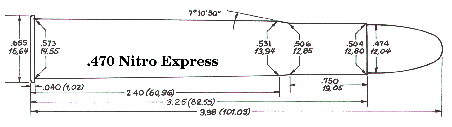 |
| Warning! Notes: rifle: Heym Double; cases: Federal; primers: Federal 215 ("Nick Harvey's Practical Reloading Manual") |
|
Cartridge History
.470 Nitro Express / .470 N.E. Data The .470 Nitro Express is one of the most historically significant and widely respected dangerous-game cartridges, introduced in 1907 by Joseph Lang during the golden age of British double rifles. It was developed as an alternative to the .450 Nitro Express following colonial restrictions, offering comparable performance while remaining legally acceptable throughout British territories. Over time, the .470 Nitro Express became one of the most widely trusted cartridges among professional hunters, known for its consistent performance, reliability and effective stopping power on the largest and most dangerous game animals. The cartridge is based on a rimmed case derived from the .500 Nitro Express, necked down to accept a .474-inch bullet. This design ensures reliable extraction and consistent operation in break-action rifles, where immediate follow-up shots are critical. Standard load data across multiple sources reflects traditional performance levels, typically featuring a 500-grain bullet at approximately 2,100 to 2,150 feet per second. These ballistics produce energy levels exceeding 5,000 foot-pounds while maintaining pressures appropriate for both modern and vintage double rifles, preserving safe and dependable operation. The .470 Nitro Express is specifically intended for dangerous-game hunting, particularly for species such as elephant and Cape buffalo where deep penetration and immediate stopping capability are essential. Bullet selection plays a critical role in achieving this performance, with solid projectiles preferred for maximum penetration and controlled-expansion bullets used when greater tissue damage is desired. The cartridge’s moderate velocity contributes to predictable bullet performance, allowing for deep, straight-line penetration through dense muscle and bone. Recoil is substantial, reflecting the cartridge’s purpose, but it remains manageable within the class of large Nitro Express cartridges. Rifles chambered for the .470 Nitro Express are typically double rifles that are carefully regulated to ensure both barrels deliver consistent accuracy. Proper rifle weight and stock geometry are essential for managing recoil and maintaining control during close-range encounters, where quick follow-up shots may be required. Despite the introduction of modern high-velocity cartridges designed for bolt-action rifles, the .470 Nitro Express continues to hold a prominent place in dangerous-game hunting. Its combination of proven performance, historical significance and dependable operation ensures its continued use among hunters and enthusiasts. Across multiple data sources, the cartridge remains defined by balance, reliability and effective stopping power, maintaining its status as one of the most trusted large-bore cartridges ever developed. Source: Wolfe Publishing (Load Data Compilation) |
| Be Alert: Publisher cannot be responsible for errors in published load data. |
| Wt. | Bullet | Powder Manufacturer | Powder | Charge | Velocity (FPS) | |
| 500 | Hawk | Alliant | RL-19 | Subscribe | 2,010 | |
| Remarks: starting load | ||||||
| 500 | Hawk | Alliant | RL-19 | Subscribe | 2,160 | |
| Remarks: maximum load | ||||||
| 500 | Hawk | Alliant | RL-22 | Subscribe | 2,010 | |
| Remarks: starting load | ||||||
| 500 | Hawk | Alliant | RL-22 | Subscribe | 2,140 | |
| Remarks: maximum load | ||||||
| 500 | Hawk | IMR | IMR-4350 | Subscribe | 1,970 | |
| Remarks: starting load | ||||||
| 500 | Hawk | IMR | IMR-4350 | Subscribe | 2,140 | |
| Remarks: maximum load | ||||||
| 500 | Hawk | IMR | IMR-4831 | Subscribe | 2,040 | |
| Remarks: starting load | ||||||
| 500 | Hawk | IMR | IMR-4831 | Subscribe | 2,170 | |
| Remarks: maximum load | ||||||
| 500 | Hawk | IMR | IMR-7828 | Subscribe | 2,000 | |
| Remarks: starting load | ||||||
| 500 | Hawk | IMR | IMR-7828 | Subscribe | 2,160 | |
| Remarks: maximum load | ||||||
| 500 | Hawk | Hodgdon | H-4350 | Subscribe | 2,030 | |
| Remarks: starting load | ||||||
| 500 | Hawk | Hodgdon | H-4350 | Subscribe | 2,140 | |
| Remarks: maximum load | ||||||
| 500 | Hawk | Hodgdon | H-450 | Subscribe | 2,050 | |
| Remarks: starting load | ||||||
| 500 | Hawk | Hodgdon | H-450 | Subscribe | 2,170 | |
| Remarks: maximum load | ||||||
| 500 | Hawk | Hodgdon | H-1000 | Subscribe | 1,950 | |
| Remarks: starting load | ||||||
| 500 | Hawk | Hodgdon | H-1000 | Subscribe | 2,060 | |
| Remarks: maximum load | ||||||
| 500 | Hawk | Hodgdon | H-4831 | Subscribe | 2,040 | |
| Remarks: starting load | ||||||
| 500 | Hawk | Hodgdon | H-4831 | Subscribe | 2,160 | |
| Remarks: maximum load | ||||||
| 600 | Hawk | Hodgdon | H-4831 | Subscribe | 1,830 | |
| Remarks: starting load | ||||||
| 600 | Hawk | Hodgdon | H-4831 | Subscribe | 1,940 | |
| Remarks: maximum load | ||||||
| 600 | Hawk | IMR | IMR-7828 | Subscribe | 1,850 | |
| Remarks: starting load | ||||||
| 600 | Hawk | IMR | IMR-7828 | Subscribe | 1,940 | |
| Remarks: maximum load | ||||||
| 600 | Hawk | Hodgdon | H-1000 | Subscribe | 1,850 | |
| Remarks: starting load | ||||||
| 600 | Hawk | Hodgdon | H-1000 | Subscribe | 1,940 | |
| Remarks: maximum load | ||||||