



.50 Alaskan Data |
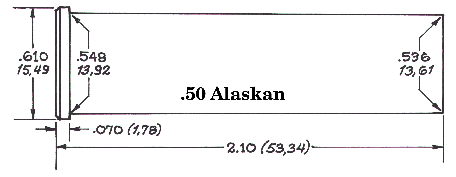 |
| Warning! Notes: All loads used CCI 200 primers. Groups fired at 50 yards with open sights over a PACT chronograph at 10 feet. Source: Wolfe Publishing — Handloader Issue #143 – January 1990 |
|
Cartridge History
.50 Alaskan Data The .50 Alaskan is one of the most famous and effective big-bore lever-action cartridges ever developed in the United States. Designed during the 1950s by Alaskan gunsmith Harold Johnson, the cartridge was created to provide hunters and guides with significantly greater stopping power than traditional lever-action cartridges available at the time. Formed by necking up the .348 Winchester case to accept .510-inch bullets, the .50 Alaskan quickly gained a reputation throughout Alaska for its ability to handle large and dangerous game at close range. Johnson originally developed the cartridge for converted Winchester Model 71 rifles, though later conversions also appeared on Winchester 1886 and Marlin 1895 platforms. The goal was to create a compact rifle capable of delivering massive penetration and dependable stopping power against brown bears, moose, and other heavy game commonly encountered in Alaska’s wilderness. Early experimentation even included modified .50 BMG projectiles, which demonstrated extraordinary penetration on large animals. Modern .50 Alaskan load data commonly includes bullets ranging from approximately 400 to 525 grains. Lighter 400- to 450-grain bullets are often capable of reaching velocities around 1,900 to over 2,000 feet per second depending on powder selection and barrel length. Heavier 500- and 525-grain bullets generally produce velocities between 1,650 and 1,850 feet per second while generating tremendous muzzle energy and deep penetration. Powders such as H-4198, IMR-4198, Reloder 7, and Benchmark are frequently used due to their ability to provide strong performance within safe pressure limits for lever-action rifles. The .50 Alaskan remains highly respected among handloaders and big-bore enthusiasts because of its unique balance between classic lever-action handling and exceptional power. Heavy hard-cast bullets are especially popular for defense against dangerous game because they retain weight well and penetrate deeply through heavy muscle and bone. While recoil from full-power loads is substantial, experienced shooters appreciate the cartridge for its authority and reliability under difficult hunting conditions. Today, the .50 Alaskan continues to maintain a loyal following despite being a relatively specialized cartridge. Companies such as Buffalo Bore and Starline have helped keep the cartridge alive through factory ammunition and brass production, while custom rifle builders continue producing modern lever-action conversions chambered for the round. More than seventy years after its creation, the .50 Alaskan remains one of the most iconic examples of American wildcat cartridge development and practical Alaskan hunting innovation. Source: Wolfe Publishing — Handloader Issue #143 – January 1990 |
| Be Alert: Publisher cannot be responsible for errors in published load data. |
| Wt. | Bullet | Powder Manufacturer | Powder | Charge | Velocity (FPS) | |
| 450 | Barnes | IMR | IMR-4198 | Subscribe | 1712 | |
| Remarks: group (inches): 1.75 | ||||||
| 450 | Barnes | IMR | IMR-4198 | Subscribe | 1796 | |
| Remarks: group (inches): 2.0 | ||||||
| 450 | Barnes | IMR | IMR-4198 | Subscribe | 1905 | |
| Remarks: group (inches): 1.63 | ||||||
| 450 | Barnes | Alliant | RL-7 | Subscribe | 1683 | |
| Remarks: group (inches): 1.0 | ||||||
| 450 | Barnes | Alliant | RL-7 | Subscribe | 1823 | |
| Remarks: group (inches): 1.0 | ||||||
| 450 | Barnes | Alliant | RL-7 | Subscribe | 1847 | |
| Remarks: group (inches): .75 | ||||||
| 450 | Barnes | Alliant | RL-7 | Subscribe | 1994 | |
| Remarks: group (inches): 1.0 | ||||||
| 485 | LBT | Alliant | RL-7 | Subscribe | 1711 | |
| Remarks: group (inches): .75 | ||||||
| 485 | LBT | Alliant | RL-7 | Subscribe | 1786 | |
| Remarks: group (inches): 1.0 | ||||||
| 485 | LBT | Alliant | RL-7 | Subscribe | 1820 | |
| Remarks: group (inches): 1.25 | ||||||
| 485 | LBT | Alliant | RL-7 | Subscribe | 1892 | |
| Remarks: group (inches): 1.75 | ||||||
| 485 | LBT | IMR | IMR-4198 | Subscribe | 1827 | |
| Remarks: group (inches): 1.75 | ||||||
| 485 | LBT | IMR | IMR-4198 | Subscribe | 1962 | |
| Remarks: group (inches): 2.0 | ||||||
| 485 | LBT | IMR | IMR-4198 | Subscribe | 1983 | |
| Remarks: group (inches): 1.25 | ||||||
| 485 | LBT | IMR | IMR-4198 | Subscribe | 1969 | |
| Remarks: group (inches): 1.75 | ||||||
| 485 | LBT | IMR | IMR-4198 | Subscribe | 1980 | |
| Remarks: group (inches): 2.75 | ||||||
| 485 | LBT | IMR | IMR-4198 | Subscribe | 2009 | |
| Remarks: group (inches): 3.25 | ||||||
| 600 | A-Square | IMR | IMR-4198 | Subscribe | 1677 | |
| Remarks: group (inches): 3.0 | ||||||
| 600 | A-Square | IMR | IMR-4198 | Subscribe | 1709 | |
| Remarks: group (inches): 1.75 | ||||||
| 600 | A-Square | IMR | IMR-4198 | Subscribe | 1739 | |
| Remarks: group (inches): .5; most accurate load | ||||||