



.50 Alaskan (Hodgdon Data) |
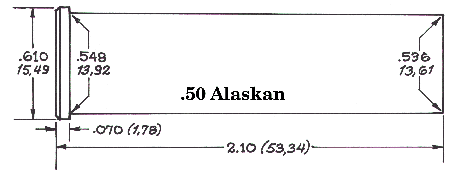 |
| Warning! Notes: case: Starline; barrel length: 22"; twist: 1:20"; trim length: 2.090"; bullet diam.: .510"; primer: CCI200; never exceed maximum loads |
|
Cartridge History
.50 Alaskan (Hodgdon Data) The .50 Alaskan remains one of the most respected big-bore lever-action cartridges ever developed, and modern Hodgdon load data continues to demonstrate the cartridge’s impressive capabilities. Originally designed during the 1950s by Alaskan gunsmith Harold Johnson, the cartridge was intended for hunters and guides needing a compact rifle with enough stopping power for large and dangerous game such as brown bear and moose. Formed from the .348 Winchester case necked up to accept .510-inch bullets, the .50 Alaskan quickly established itself as a serious heavy-game cartridge with tremendous close-range authority. Hodgdon data for the .50 Alaskan highlights the cartridge’s flexibility with a wide range of heavy bullets and medium-fast rifle powders. Common bullet weights include 435-, 450-, 500-, and 525-grain projectiles, with many loads using hard-cast lead bullets or flat-point jacketed hunting bullets designed specifically for tubular magazine rifles. Powders such as H-322, H-4198, and Benchmark are frequently recommended due to their ability to provide strong velocity while maintaining safe pressure levels within lever-action platforms. According to published Hodgdon data, 435-grain bullets can exceed 2,000 feet per second when paired with H-4198 powder, while heavier 525-grain cast bullets commonly produce velocities ranging from approximately 1,700 to 1,850 feet per second depending on the load. These heavy projectiles generate substantial muzzle energy and deep penetration, making the cartridge highly effective for large game in dense brush or dangerous conditions. Many shooters favor hard-cast gas-checked bullets for maximum penetration against heavy bone and thick muscle tissue. Modern .50 Alaskan rifles are commonly built on converted Marlin and Winchester lever-action platforms, often featuring strengthened actions, improved sights, and shortened barrels for easier handling in wilderness environments. Companies such as Buffalo Bore have also contributed to the cartridge’s popularity by offering powerful factory ammunition for hunters who do not handload their own ammunition. Despite the rise of modern magnum cartridges, the .50 Alaskan continues to attract enthusiasts who appreciate its combination of classic lever-action styling and tremendous stopping power. Recoil from full-power .50 Alaskan loads is substantial and can be punishing in lighter rifles. However, experienced shooters often praise the cartridge for its reliability, authority, and effectiveness on large game at practical hunting distances. More than seventy years after its introduction, the .50 Alaskan remains an iconic example of American wildcat cartridge innovation and Alaskan hunting practicality. Source: Wolfe Publishing — .50 Alaskan (Hodgdon Data) |
| Be Alert: Publisher cannot be responsible for errors in published load data. |
| Wt. | Bullet | Powder Manufacturer | Powder | Charge | Velocity (FPS) | |
| 435 | LFN W/GC | Hodgdon | H-322 | Subscribe | 1,856 | |
| Remarks: starting load; COL: 2.460"; 25,500 cup | ||||||
| 435 | LFN W/GC | Hodgdon | H-322 | Subscribe | 1,994 | |
| Remarks: maximum load; COL: 2.460"; 33,800 cup | ||||||
| 435 | LFN W/GC | Hodgdon | H-4198 | Subscribe | 1,912 | |
| Remarks: starting load; COL: 2.460"; 26,100 cup | ||||||
| 435 | LFN W/GC | Hodgdon | H-4198 | Subscribe | 2,089 | |
| Remarks: maximum load; COL: 2.460"; 35,500 cup | ||||||
| 450 | Barnes FP | Hodgdon | Benchmark | Subscribe | 1,718 | |
| Remarks: starting load; COL: 2.420"; 26,400 cup | ||||||
| 450 | Barnes FP | Hodgdon | Benchmark | Subscribe | 1,878 | |
| Remarks: maximum load; COL: 2.420"; 35,100 cup | ||||||
| 450 | Barnes FP | Hodgdon | H-322 | Subscribe | 1,732 | |
| Remarks: starting load; COL: 2.420"; 26,200 cup | ||||||
| 450 | Barnes FP | Hodgdon | H-322 | Subscribe | 1,876 | |
| Remarks: maximum load; COL: 2.420"; 34,600 cup | ||||||
| 450 | Barnes FP | Hodgdon | H-4198 | Subscribe | 1,772 | |
| Remarks: starting load; COL: 2.420"; 24,700 cup | ||||||
| 450 | Barnes FP | Hodgdon | H-4198 | Subscribe | 1,940 | |
| Remarks: maximum load; COL: 2.420"; 35,300 cup | ||||||
| 500 | JFP | Hodgdon | H-322 | Subscribe | 1,674 | |
| Remarks: starting load; COL: 2.500"; 25,900 cup | ||||||
| 500 | JFP | Hodgdon | H-322 | Subscribe | 1,819 | |
| Remarks: maximum load; COL: 2.500"; 33,900 cup | ||||||
| 500 | JFP | Hodgdon | H-4198 | Subscribe | 1,719 | |
| Remarks: starting load; COL: 2.500"; 28,600 cup | ||||||
| 500 | JFP | Hodgdon | H-4198 | Subscribe | 1,854 | |
| Remarks: maximum load; COL: 2.500"; 34,500 cup | ||||||
| 525 | LFN W/GC | Hodgdon | Benchmark | Subscribe | 1,694 | |
| Remarks: starting load; COL: 2.520"; 25,800 cup | ||||||
| 525 | LFN W/GC | Hodgdon | Benchmark | Subscribe | 1,820 | |
| Remarks: maximum load; COL: 2.520"; 34,300 cup | ||||||
| 525 | LFN W/GC | Hodgdon | H-322 | Subscribe | 1,691 | |
| Remarks: starting load; COL: 2.520"; 27,100 cup | ||||||
| 525 | LFN W/GC | Hodgdon | H-322 | Subscribe | 1,823 | |
| Remarks: maximum load; COL: 2.520"; 34,200 cup | ||||||
| 525 | LFN W/GC | Hodgdon | H-4198 | Subscribe | 1,724 | |
| Remarks: starting load; COL: 2.520"; 27,300 cup | ||||||
| 525 | LFN W/GC | Hodgdon | H-4198 | Subscribe | 1,852 | |
| Remarks: maximum load; COL: 2.520"; 34,800 cup | ||||||