



.50 Browning (Accurate Rifle Data) |
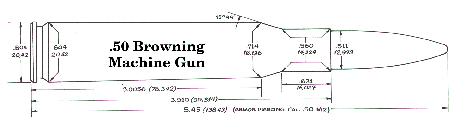 |
| Warning! Notes: gun: FRESHOUR; barrel length: 44 inches; primer: CCI 35; case: IMI; maximum loads; reduce listed loads by 10 percent for a start charge |
|
Cartridge History
.50 Browning (Accurate Rifle Data) The .50 Browning Machine Gun cartridge, commonly known as the .50 BMG or .50 Browning, is one of the most powerful and historically significant military cartridges ever produced. Developed by John Moses Browning during the closing years of World War I, the cartridge was intended for use in the Browning M2 heavy machine gun to provide long-range firepower against personnel, vehicles, aircraft, and lightly armored targets. Official military adoption occurred during the early 1920s, and more than a century later, the cartridge remains in active military service throughout the world. The .50 Browning uses a large bottlenecked case measuring 99mm in length and fires .510-inch diameter bullets. Military projectiles traditionally weigh between 647 and 750 grains, although modern sporting and match bullets are available in a much broader selection of weights and designs. Typical velocities range from approximately 2,700 to over 3,000 feet per second depending on bullet weight, barrel length, and powder selection. These performance levels allow the cartridge to maintain tremendous energy and excellent ballistic performance at extreme distances. Accurate rifle data for the .50 Browning includes a wide variety of heavy bullets and slow-burning powders specifically designed for extremely large-capacity cartridges. Powders such as Accurate 8700, Accurate 5010, and other similar slow-burning propellants are frequently used because they provide consistent pressure curves and efficient velocity production in long-barreled rifles. Handloaders commonly pair these powders with precision match bullets for long-range target shooting or solid projectiles intended for maximum penetration and retained energy. The cartridge gained substantial popularity among civilian shooters during the late twentieth century as surplus rifles and components became increasingly available. Modern .50 BMG rifles are commonly used in extreme long-range shooting competitions where shooters engage steel targets at distances well beyond 1,000 yards. The cartridge’s heavy bullets offer exceptional ballistic coefficients, impressive wind resistance, and tremendous retained energy at long distances, making it one of the most effective long-range cartridges ever developed. Although the .50 Browning delivers extraordinary performance, it also requires specialized rifles, large quantities of powder, and carefully assembled ammunition. Recoil is substantial even in heavy rifles equipped with advanced muzzle brakes, and both rifles and ammunition are considerably more expensive than traditional sporting cartridges. Nevertheless, the .50 BMG continues to maintain legendary status among military historians, long-range competitors, and firearm enthusiasts because of its unmatched combination of power, range, and historical significance. |
| Be Alert: Publisher cannot be responsible for errors in published load data. |
| Wt. | Bullet | Powder Manufacturer | Powder | Charge | Velocity (FPS) | |
| 642 | Military FMJ | Accurate | AAC-8700 | Subscribe | 2,930 | |
| Remarks: | ||||||
| 750 | Military FMJ | Accurate | AAC-8700 | Subscribe | 2,700 | |
| Remarks: | ||||||