



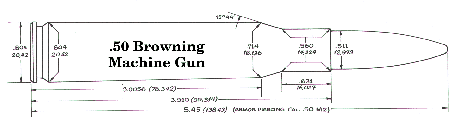
.50 Browning Machine Gun / .50 BMG (Handloader issue #350) |
 |
| Warning! A 50 BMG-chambered rifle that was built around a Rock McMillan action and a 30-inch K&P Gun Company barrel fitted with a K&P clamshell-type muzzle brake with a Burris XTR III 5.5-30x 56mm riflescope cradled in Burris XTR Signature Rings was used to test all loads. Once-fired Hornady Match Grade 50 BMG cases and CCI No. 35 primers, assembled using a RCBS Big Max press and RCBS dies were used throughout. Velocities were recorded by an Oehler 35P per the SAAMI standard Z299.4-2015, Section III, Equipment: Schematic Velocity Test Layout for Instrumental Velocity protocol. The 50 BMG is not a SAAMI standardized cartridge. Cartridge case, projectile, chamber and barrel specifications may vary more than the norm. This necessitates exercising more caution when developing loads for the 50 BMG cartridge and the specific firearm they will be fired in. |
|
Cartridge History
.50 Browning Machine Gun / .50 BMG (Handloader Issue #350) The .50 Browning Machine Gun cartridge, more commonly known as the .50 BMG, is one of the most respected and powerful rifle cartridges ever developed. Designed by John Moses Browning during World War I, the cartridge was created for military applications requiring tremendous long-range power, armor penetration, and reliability. Officially adopted alongside the Browning M2 heavy machine gun in the early 1920s, the .50 BMG has remained in continuous military service for more than a century and is still widely used around the world today. The cartridge utilizes a large bottleneck case firing a .510-inch diameter projectile. Traditional military loads commonly use bullets weighing between 647 and 750 grains, though modern match and specialty bullets now span a broader range of designs and weights. With velocities often exceeding 2,700 feet per second, the .50 BMG delivers extraordinary energy and exceptional long-range performance. Its ability to remain effective at distances well beyond one mile has made it a dominant force in extreme long-range shooting. Over the years, the .50 BMG evolved far beyond its military origins and became highly respected among civilian precision shooters and reloaders. Specialized rifles built around heavy-duty bolt actions and match-grade barrels are now commonly used in competition, recreational long-range shooting, and specialized heavy-game hunting applications where legal. Advances in optics, bullet design, and propellant technology have significantly improved the cartridge’s accuracy potential compared to earlier decades. Handloader Issue #350 focused on modern .50 BMG load development using contemporary components and propellants, including slow-burning magnum rifle powders and high-ballistic-coefficient bullets intended for extreme-distance shooting. The article emphasized the importance of rifle-specific load development, careful case preparation, and proper pressure evaluation due to differences in chamber dimensions and component specifications between rifles. Reloading the .50 BMG requires specialized presses, dies, shell holders, and measuring equipment capable of handling the cartridge’s enormous dimensions and powder capacity. Bullet seating precision, primer consistency, neck tension, and case trimming all play major roles in producing dependable ammunition for extreme long-range applications. Because of the cartridge’s immense operating pressures and recoil, careful adherence to tested load data is essential for both safety and performance. More than one hundred years after its creation, the .50 BMG continues to stand as one of the most iconic cartridges in firearms history. Its combination of military heritage, unmatched power, and exceptional long-range capability ensures its lasting place among the world’s most influential rifle cartridges. |
| Be Alert: Publisher cannot be responsible for errors in published load data. |
| Wt. | Bullet | Powder Manufacturer | Powder | Charge | Velocity (FPS) | |
| 650 | M33 FMJ | Alliant | RL-50 | Subscribe | 3169 | |
| Remarks: COAL (inches): 5.470; 3-shot 500-yard group (inches): 12.0 | ||||||
| 750 | Hornady A-MAX | Alliant | RL-50 | Subscribe | 2380 | |
| Remarks: COAL (inches): 5.730; 3-shot 500-yard group (inches): 3.75 | ||||||
| 750 | Hornady A-MAX | Alliant | RL-50 | Subscribe | 2637 | |
| Remarks: COAL (inches): 5.730; 3-shot 500-yard group (inches): 3.50 | ||||||
| 800 | Barnes LRS BT Banded Solid Bore Rider | Alliant | RL-50 | Subscribe | 2725 | |
| Remarks: COAL (inches): 5.730; 3-shot 500-yard group (inches): 4.50 | ||||||