



.50 Browning Machine Gun / .50 BMG |
 |
| Warning! |
|
Cartridge History
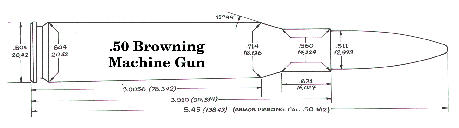
.50 Browning Machine Gun / .50 BMG The .50 Browning Machine Gun cartridge, universally known as the .50 BMG, is one of the most powerful and historically important military cartridges ever developed. Designed by John Moses Browning during the final years of World War I, the cartridge was created to give American forces a heavy machine gun round capable of defeating light armor, damaging aircraft, and engaging enemy equipment at long distances. Official adoption came alongside the Browning M2 heavy machine gun during the early 1920s, beginning a service life that continues more than one hundred years later. The cartridge features a massive bottleneck case firing a .510-inch diameter bullet. Traditional military projectiles generally weigh between 647 and 750 grains, although modern sporting and specialty bullets cover a much wider range of weights and designs. With muzzle velocities commonly exceeding 2,700 feet per second, the .50 BMG delivers extraordinary energy and long-range capability that few cartridges can rival. Although originally intended strictly for military use, the .50 BMG eventually found a major following among civilian shooters. Advances in rifle design and optics helped establish the cartridge as a dominant force in extreme long-range shooting. Precision rifles chambered for the .50 BMG are now commonly used in competitive target shooting, recreational long-range shooting, and specialized hunting applications where legal. Its ability to remain effective well beyond a mile has made it legendary among precision shooters. Handloading the .50 BMG requires specialized equipment and careful attention to detail due to the cartridge’s enormous size and operating pressures. Large-capacity cases require slow-burning powders and precise charge measurements to ensure safe and consistent performance. Case preparation, primer seating, bullet concentricity, and overall cartridge length all play important roles in producing reliable ammunition for long-range accuracy. Because of the extreme distances often involved, many reloaders carefully tailor loads to specific rifles and environmental conditions. By the mid-1980s, interest in the .50 BMG among civilian shooters had grown steadily as surplus components and specialized rifles became more accessible. Articles and load data published during this period helped expand knowledge surrounding safe handloading practices and long-range applications for the cartridge. The .50 BMG’s blend of military history, engineering durability, and unmatched ballistic performance continues to attract enthusiasts from around the world. |
| Be Alert: Publisher cannot be responsible for errors in published load data. |
| Wt. | Bullet | Powder Manufacturer | Powder | Charge | Velocity (FPS) | |
| 600 | NEI 600-510GC | IMR | IMR-4064 | Subscribe | 1,900 | |
| Remarks: velocity from 36 inch barrel, RWS primers in LC cases | ||||||
| 600 | NEI 600-510GC | IMR | IMR-3031 | Subscribe | 1,900 | |
| Remarks: velocity from 36 inch barrel, RWS primers in LC cases | ||||||
| 600 | NEI 600-510GC | IMR | IMR-4198 | Subscribe | 1,400 | |
| Remarks: requires black powder booster if using large rifle primers; velocity from 36 inch barrel, RWS primers in LC cases | ||||||
| 662 | M33 | Winchester | W-785 | Subscribe | 2,800 | |
| Remarks: velocity from 36 inch barrel, RWS primers in LC cases | ||||||
| 662 | M33 | IMR | IMR-5010 | Subscribe | 2,800 | |
| Remarks: velocity from 36 inch barrel, RWS primers in LC cases | ||||||
| 662 | M33 | Hodgdon | H-4831 | Subscribe | 2,800 | |
| Remarks: velocity from 36 inch barrel, RWS primers in LC cases | ||||||
| 662 | M33 | Accurate | MR-8600 | Subscribe | 3,100 | |
| Remarks: velocity from 44 inch barrel, TCCI primers in LC cases | ||||||
| 662 | M33 | IMR | IMR-4350 | Subscribe | 2,750 | |
| Remarks: maximum; velocity from 36 inch barrel,RWS primers in LC cases | ||||||
| 662 | M33 | Accurate | MR-8700 | Subscribe | 2,750 | |
| Remarks: velocity from 36 inch barrel, RWS primers in LC cases | ||||||
| 710 | APM2 | Winchester | W-785 | Subscribe | 2,800 | |
| Remarks: velocity from 36 inch barrel, RWS primers in LC cases | ||||||
| 710 | APM2 | IMR | IMR-5010 | Subscribe | 2,800 | |
| Remarks: velocity from 36 inch barrel, RWS primers in LC cases | ||||||
| 710 | APM2 | Hodgdon | H-4831 | Subscribe | 2,800 | |
| Remarks: velocity from 36 inch barrel, RWS primers in LC cases | ||||||
| 710 | APM2 | Accurate | MR-8600 | Subscribe | 3,100 | |
| Remarks: velocity from 44 inch barrel, TCCI primers in LC cases | ||||||
| 710 | APM2 | IMR | IMR-4350 | Subscribe | 2,750 | |
| Remarks: maximum; velocity from 36 inch barrel, RWS primers in LC cases | ||||||
| 710 | APM2 | Accurate | MR-8700 | Subscribe | 2,750 | |
| Remarks: velocity from 36 inch barrel, RWS primers in LC cases | ||||||