



9mm Luger(Handloader Issue #359) |
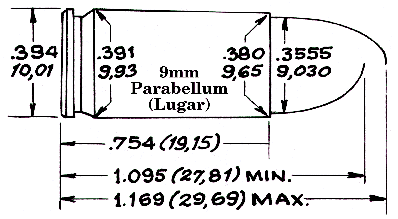 |
| Warning! Load Notes: A SIG Sauer P320 chambered in 9mm Luger with a 4.7-inch barrel was used to test all loads. New Starline cases and CCI 500 Small Pistol primers were used throughout. Jacketed bullets measured .355 inch in diameter. Maximum case length is 0.754 inch, with a recommended trim-to length of 0.749 inch. SAAMI maximum overall cartridge length is 1.169 inches. A taper crimp measuring 0.373 inch was applied to all loads. All data remained within the SAAMI maximum average pressure specification of 35,000 psi. Accuracy was established by firing a single five-shot group for each load. |
|
Cartridge History
9mm Luger The 9mm Luger, also known as the 9mm Parabellum or 9x19mm, is the most widely used centerfire handgun cartridge in the world. Developed in 1902 by German firearms designer Georg Luger for the Luger self-loading pistol, the cartridge was designed to provide reliable function in semi-automatic handguns while delivering practical power, manageable recoil, and excellent accuracy. More than a century later, the 9mm remains the standard military, law enforcement, and civilian handgun cartridge for much of the world. Its longevity and popularity are a testament to the soundness of its original design. The cartridge was developed from the earlier 7.65x21mm Luger by shortening the case neck and accepting a larger diameter bullet, resulting in improved terminal performance while maintaining reliable feeding characteristics. :contentReference[oaicite:0]{index=0} The 9mm Luger gained international recognition after being adopted by the German military prior to World War I. Over the following decades, it spread throughout Europe and eventually became one of the most commonly chambered pistol cartridges worldwide. After World War II, widespread military adoption by NATO further cemented its position as a global standard. Today, countless pistols, carbines, and submachine guns are chambered for the cartridge, ranging from duty handguns and concealed-carry pistols to competition firearms and personal-defense carbines. :contentReference[oaicite:1]{index=1} One of the greatest strengths of the 9mm Luger is its balance of performance and shootability. Standard bullet weights generally range from 90 to 147 grains, with velocities varying according to firearm type and barrel length. The cartridge produces moderate recoil that allows rapid follow-up shots while still providing sufficient energy for defensive, sporting, and recreational use. Modern bullet technology has significantly improved the effectiveness of defensive loads, helping the 9mm become the preferred choice for many law enforcement agencies that once favored larger-caliber cartridges. For handloaders, the 9mm Luger offers tremendous versatility. Brass is widely available, component selection is extensive, and numerous powders can be used successfully. Handloaders can assemble economical practice ammunition, competition loads tailored for specific power factors, or defensive-performance loads suitable for modern handguns. Because it operates at relatively high pressures, proper load development and adherence to published data are especially important, but the cartridge rewards careful handloading with excellent consistency and accuracy. The cartridge has also become a dominant force in competitive shooting disciplines. Organizations such as USPSA, IPSC, IDPA, and Steel Challenge frequently see competitors using 9mm handguns because of the cartridge's low recoil, affordability, and reliability. Its popularity has encouraged firearm manufacturers to develop an enormous variety of pistols, resulting in more handgun choices than perhaps any other cartridge in history. Today, the 9mm Luger stands as one of the most influential cartridges ever created. Its combination of efficiency, accuracy, reliability, and worldwide availability has allowed it to remain relevant through more than 120 years of firearms development. Whether used for self-defense, competition, recreational shooting, or professional service, the 9mm continues to set the standard by which modern handgun cartridges are judged. |
| Be Alert: Publisher cannot be responsible for errors in published load data. |
| Wt. | Bullet | Powder Manufacturer | Powder | Charge | Velocity (FPS) | |
| 115 | Hornady XTP | IMR | IMR Blue | Subscribe | 1334 | |
| Remarks: COAL(inches): 1.075; 20-yard group (inches): 2.70 | ||||||
| 124 | Speer Gold Dot HP | Hodgdon | CFE Pistol | Subscribe | 1224 | |
| Remarks: COAL(inches): 1.120; 20-yard group (inches): 2.55 | ||||||
| 147 | Nosler Sporting HG JHP | Alliant | Power Pistol | Subscribe | 1064 | |
| Remarks: COAL(inches): 1.120; 20-yard group (inches): 2.50 | ||||||